
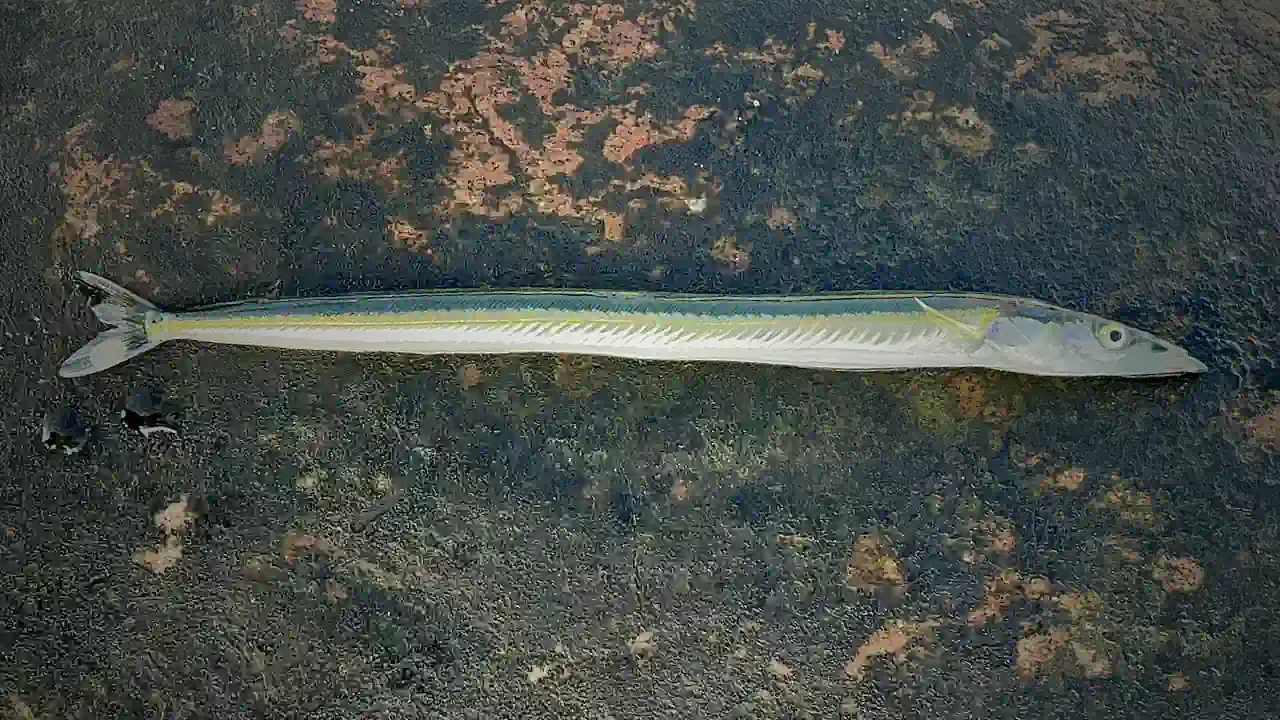
Common sand eel, Ammodytes tobianus
How the common sand eel lives, feeds and supports sea trout in the coastal waters around Funen.
The common sand eel, a slender and vital inhabitant of our coastal waters.
Morphology and identifying features
The common sand eel has a slender, cylindrical body and typically reaches 12–15 cm in length. Its subterminal mouth sits below the snout and helps it feed in the sand. The dorsal fin has 39–46 soft rays, which distinguish it from the lesser sand eel, Ammodytes marinus, and the two Hyperoplus species. A narrow golden stripe runs along the lateral line and appears silver in backlight.
Distribution in the waters around Funen
In the South Funen archipelago, including Odense Fjord, Svendborg Sound, Helnæs Bay, around Langeland and Ærø, the common sand eel is among the most widespread coastal fish. DTU Aqua research on sandeel habitat and sand preference helps explain why it prefers fine-grained sandy flats at depths of 1–15 m, though under calm conditions it has been recorded down to 30 m. Most catch and survey data from Funen show dense schools on flat sandbanks free of seaweed or larger stones.
Life cycle and reproduction
Common sand eels reach sexual maturity at 1–2 years of age and live for 3–5 years. They spawn from December to February, when adults move to deeper sandbanks and deposit eggs and sperm in the top layer of sand. The eggs remain protected there until they begin to hatch in March or April. The larvae drift into nearshore plankton zones and develop into juveniles. After 2–4 weeks, they descend to the seabed and begin the same cycle as adults.
Feeding habits and ecological significance
As a zooplanktivore the common sand eel feeds mainly on small crustaceans, including amphipods, harpacticoid copepods and larvae of benthic invertebrates. This diet ensures stable energy transfer from microscopic plankton communities to larger predators. In Funen’s coastal waters sand eels are one of the sea trout’s preferred prey, and field studies in Odense Fjord show they can account for up to 60 % of sea trout diet during the fishing season. Their high availability and nutritional value make them central to maintaining sea trout populations and benefiting both ecological balance and recreational fishing.
Behaviour and daily rhythm
Sand eels display a distinct daily cycle tied to light conditions and food availability. At dawn, they burrow upwards from the sand to forage in the upper sediment where plankton concentrations are highest. At midday, some schools may move to deeper water to reduce predation risk. At sunset, they re-bury themselves in the sand and remain inactive all night. This behaviour protects them from nocturnal predators and optimises energy conservation.
Seasonal activity variations
During the summer months (June–August), the common sand eel experiences its greatest growth and activity due to warm water temperatures and abundant food. In autumn (September–November), adults begin migrating towards winter spawning grounds and daily feeding is reduced. In winter (December–February), feeding intervals lengthen and energy consumption is minimised while reproduction takes precedence. In spring (March–May), eggs hatch and larvae drift towards the coast before quickly adopting a bottom-dwelling lifestyle.
Threats and conservation measures
Sand eel populations in Funen waters face several pressures. Coastal development and sand extraction can damage key sandbanks, while eutrophication and sedimentation reduce water quality. Climate change also shifts plankton communities and may limit food. Monitoring populations, protecting spawning areas and regulating sand extraction can support long-term survival. Local citizen-science projects on Funen also provide useful conservation data.
Conclusion
The common sand eel, Ammodytes tobianus, is a keystone species in the South Funen archipelago. Its morphology, life cycle and behaviour are closely adapted to sandy seabeds. Its role as one of sea trout’s preferred prey underlines its importance for both ecosystem health and recreational fishing. Management efforts that protect its habitats and ensure steady food availability are essential to preserve this species in Danish waters.